


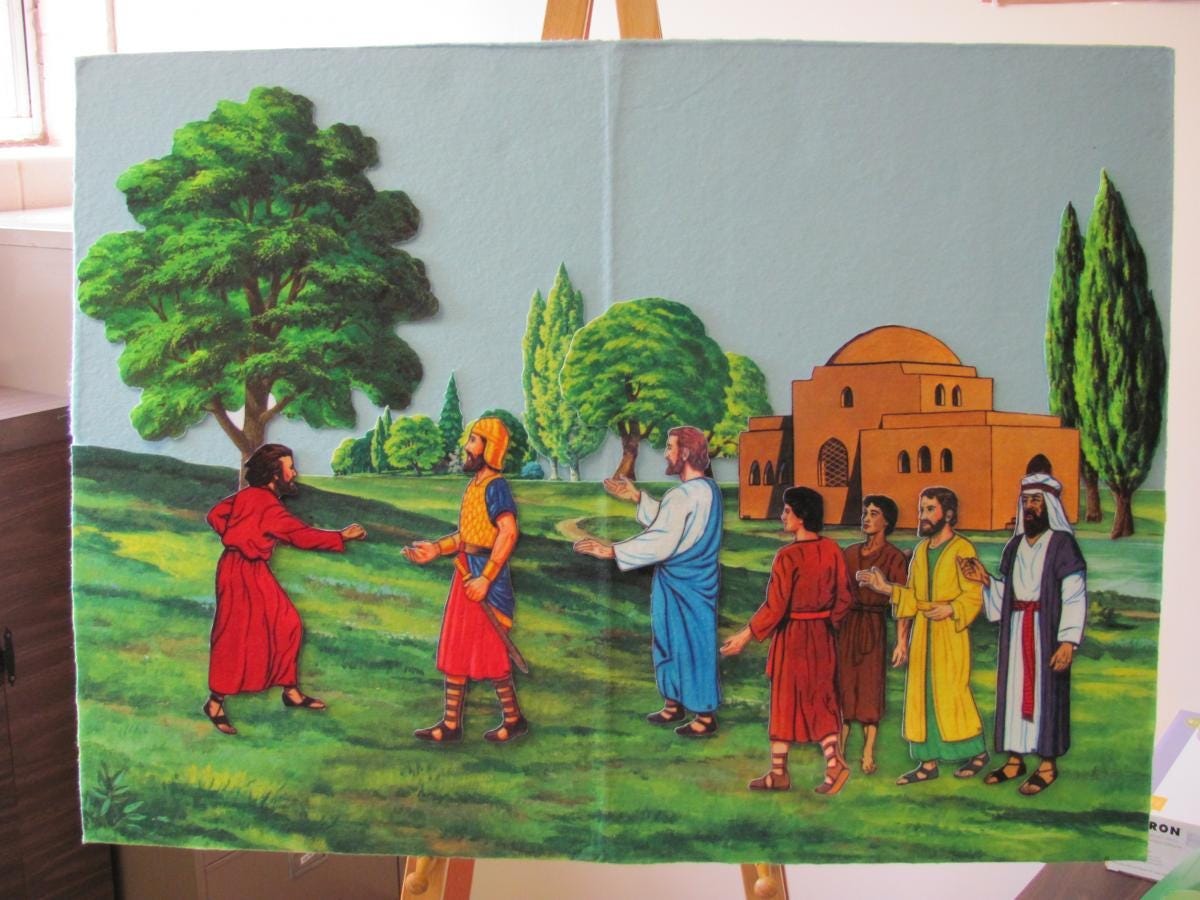
I grew up learning the Bible on flannel board. Or maybe it’s called a flannelgraph? I am not sure.
One week it was Noah and then next week it was David with a felt slingshot. David would come down and be replaced with Daniel standing calm in a den of lions. And what I remember was each story was told with its own moral. Be brave like David. Be faithful like Daniel. Obey like Noah. Honestly, as a kid, I loved it. But what I absorbed from a young age was the Bible was a bucket of stories and inside that bucket were little jars with stories and lessons sealed inside. Nothing connected Noah to David. And when I got older it felt like the jars got smaller. Those stories became verses and the verses became like fortune cookies. I would write Philippians 4:13 under my baseball hat in high school. I would quote Jeremiah 29:11 to my girlfriend as I filled out my college applications. And I would never once stop and wonder what larger thing each verse might belong to.
But here is what I wish someone would have told me as I was sitting and staring at that felt board full of lions:
All of those pieces are chapters of a single story, and the story is going somewhere.
The whole point of reading is to find out where.
The Story Jesus Lived Inside
Jesus didn’t learn his Scriptures through flannel boards and as a bucket of jars. He would have learned them as family’s story. The saga of a particular people. He would have heard the creation account, the promise, slavery, exodus, covenant, the land, kings, prophets, exile, and the long ache of waiting for God to come back and set things right. First- century Jews would have carried that story in their bones. The Scriptures were the record of where that story had been and the promise of where it was headed.
So watch what Jesus does with that story. He walks into the synagogue in Nazareth and reads Isaiah’s promise of good news to the poor and then tells the people that today this Scripture is fulfilled in your hearing. Now, fulfilled is a story word. It is a word you use when a plot finally turns. In the Sermon in the Mount, he says he has come not to abolish the Law and the Prophets but instead to fulfill them. To carry the story forward to what it was always reaching toward. And his favorite phrase, the kingdom of God, was a plot announcement. It means the things your whole story has been waiting for is happening now.
And then in one of my favorite scenes in all the gospels, on the road to Emmaus, the risen Jesus falls in step with two heartbroken disciples, and Luke tells us that beginning with Moses and all the prophets, Jesus interpreted to them the things concerning himself in all the Scriptures. He started with Moses and told them the whole story front to back so they could see where it had been going. Their hearts burned, they said afterwards. Hearts burn over stories.
What Changes When the Bible is a Story
A story asks different questions than a jar of morals asks. Because you stop asking what the rule is here and start asking where this is headed. What is God up to? What kind of God keeps showing up in these pages? Genesis stops being a science debate. The strange laws become a chapter about a people learning to be different from empire. The prophets become the story’s conscience and call the characters back to the plot. And the difficult passages become moments in a story that is bending slowly and stubbornly toward the love of God and neighbor that bears the load of the whole thing. (Like we talked about in part 2.)
But you are in the story too, by the way. That is the wild part. The same story that carried Abraham and Ruth and Mary is still moving, and your one life is a scene in that story.
Next week we will wrap up this series by getting practical. We will explore what it looks like to actually read the Bible this way. I am looking forward to it.

I want to encourage you this week to pick one gospel. Mark is the shortest. But read an entire gospel in one or two sittings the way you would read a novel. Don’t stop to read any study notes or try to solve anything in your brain, just follow the story and notice what Jesus is like when you take him in whole. Most of us probably haven’t done this, and I think it changes things.

Reading the Bible Again for the First Time by Marcus Borg. I love Borg, and he writes for people like me who learned the jar-of-morals Bible. He is so patient, clear, and unafraid of your questions. His way of reading Scripture as sacred story has helped a lot of people fall back in love with a book they had given up on. Pick it up and see what you think.


Our Labor Day weekend was packed full of excitement. On Friday night my wife had a work party at Kauffman Stadium (home of the Kansas City Royals). So that was a treat.

Then, on Saturday night, we hung out with some dear friends and played pickleball (my first time ever) and listened to some live music. SO fun.
Finally, on Sunday our whole family went back to Kauffman Stadium for another Royals game! A family in our church so generously gifted us 4 tickets behind home-plate.


We don’t get to experience too many weekends like this one, so I am still soaking it all in. Grateful is an understatement.
What did you do for Labor Day weekend?
Let me know in the comments.
I love this full-story way of teaching that is coming back to the church. Taking the long view of biblical history rather than cherry picking verses or sections as self-improvement advice.
Maybe this is why proof-texting gets so ugly. Once the Bible becomes a jar of disconnected verses, you can shake out whichever one justifies what you already wanted to believe. A story is harder to control. It keeps asking where the whole thing is going, who God is becoming clearer as, and whether your favorite verse still looks holy when you put it back into the larger arc.