
SNAP Cuts and Selective Literalism
How ignoring context turns Scripture into a weapon against the poor.
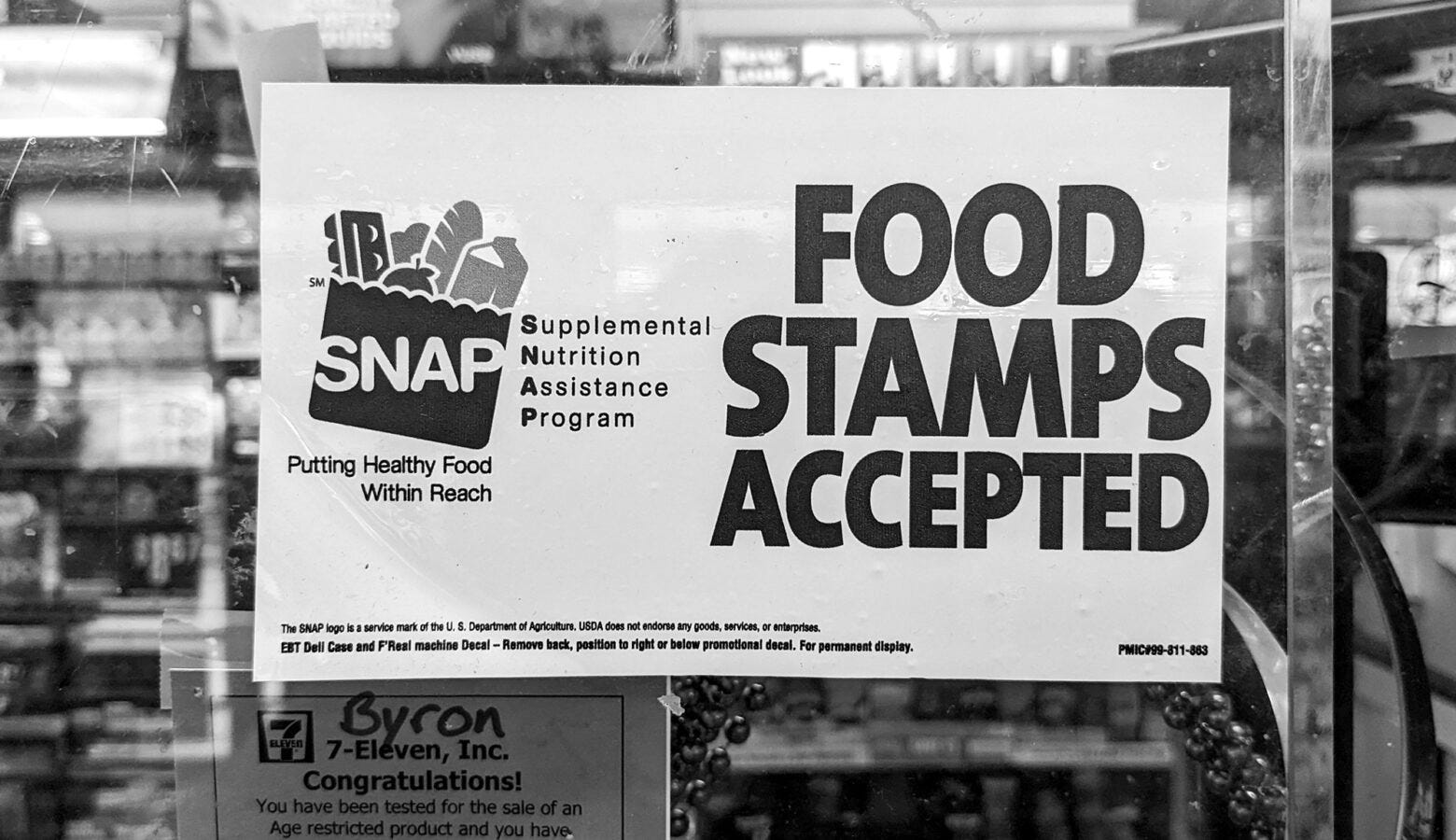
If you haven’t heard yet, millions of low-income Americans will lose access to food aid on Nov. 1, when half of states plan to cut off benefits due to the government shutdown.
Twenty-five states have said they are issuing notices informing participants of the Supplemental Nutrition Assistance Program, the nation’s largest anti-hunger initiative, that they won’t receive checks next month. Those states include California, Arkansas, Hawaii, Indiana, Mississippi and New Jersey.1
Christians should be the loudest voices against this, but too many are busy justifying it with a single verse of Scripture.
The Verse They Love to Quote
I am no stranger to this rhetoric. I grew up hearing 2 Thessalonians 3:10 weaponized. “If anyone is not willing to work, let him not eat.” Case closed. Scripture said it. The lazy can starve. It wasn’t until years later, when I actually began reading the letter to the Thessalonians in context, that I realized how catastrophically we’d missed the point. Paul wasn’t writing public policy recommendations for a 21st-century democracy. He was addressing a very specific problem in a very specific church where some believers had stopped working because they thought Jesus was coming back at any moment. They’d quit their jobs and were mooching off the generosity of other church members while they waited for the Second Coming. Paul’s response wasn’t “cut off all social safety nets and let the poor starve.” It was “hey, get back to work and stop being a burden on your church family while you wait.”
The context matters. Paul had just spent the previous chapter talking about how believers should encourage each other and support the weak. He’d been clear throughout his letters about the church’s responsibility to care for those genuinely in need.
The Verses They Conveniently Forget
Here’s what kills me about watching politicians, pundits, and Christians pull out this one verse to justify gutting SNAP benefits: they act like it’s the only thing Scripture has to say about hunger and poverty. They quote Paul’s one corrective to a specific situation and ignore the thundering chorus of over 2,000 verses commanding God’s people to care for the poor, feed the hungry, and defend the vulnerable. It’s not even close. The Bible is practically obsessed with how we treat those who have nothing.
Leviticus 19:10 commands farmers to leave the edges of their fields unharvested so the poor can eat. Deuteronomy 15:11 says “there will always be poor people in the land, therefore I command you to be openhanded toward your fellow Israelites who are poor and needy.” Proverbs 19:17 goes so far as to say that whoever is kind to the poor lends to the Lord himself. Isaiah 58 tells us that the kind of fasting God desires isn’t religious performance but sharing our food with the hungry and bringing the poor into our homes. Jesus launches his ministry in Luke 4 by announcing good news to the poor and kicks off the Sermon on the Mount by blessing them. He feeds thousands with loaves and fish, and he promises in Matthew 25 that how we treat the hungry, the stranger, the naked, and the imprisoned is how we treat him.
The biblical witness isn’t ambiguous here. God is unequivocally, passionately, relentlessly on the side of the poor. Every major prophet rails against societies that neglect the vulnerable. The psalms repeatedly celebrate God as the defender of the fatherless and the widow. The early church in Acts shares everything in common so that no one goes without. James says that religion that doesn’t care for orphans and widows is worthless. This isn’t a side issue in Scripture. This is the issue. You cannot read the Bible honestly and come away thinking God is fine with people going hungry.
Selective Literalism and the Politics of Scarcity
What we’re watching is selective literalism in service of a political agenda. The same voices that want to apply 2 Thessalonians 3:10 with rigid literalism to justify cutting food assistance have no interest in applying that same literalism to Jesus’s command to sell all you have and give to the poor, or his warning that it’s easier for a camel to go through the eye of a needle than for a rich person to enter the kingdom of God. They don’t want to talk about Amos pronouncing judgment on those who “trample on the needy and bring ruin to the poor of the land.” They’re not quoting Ezekiel 16:49, where the sin of Sodom is described as having “excess of food” while not helping “the poor and needy.”
When we take one verse and use it to build walls, justify scarcity, or to punish people, we’re not reading Scripture faithfully. We’re conscripting it into our culture wars. We’re making Paul say things he never meant to advance policies that directly contradict the heart of the God he served.
The “Church’s Job” Dodge
The other line I hear constantly is this: “It’s the church’s job to feed the poor, not the government’s.” It sounds spiritual. It sounds like we’re defending the proper role of the church. But it’s mostly just a way to absolve ourselves of responsibility while feeling righteous about it.
Let’s be honest about what this argument actually means in practice. The church in America, for all our buildings and budgets and good intentions, is not currently feeding the hungry at anywhere near the scale needed. We’re not even close. According to Feeding America, over 47 million Americans face food insecurity.2 The church runs food pantries and soup kitchens, and that work is beautiful and necessary, but it’s a drop in the bucket compared to the need. SNAP serves roughly 42 million people.3 There is no universe in which the American church could suddenly absorb that responsibility if the government cuts the program. We don’t have the infrastructure, the volunteers, or the funding.
But here’s the deeper problem with the “church’s job” argument: it creates a false dichotomy. Who says it has to be either-or? The biblical command to care for the poor doesn’t come with a footnote that says “only through religious institutions.” When Scripture tells us to feed the hungry, it’s speaking to all of us, in all the ways we organize our common life together. Government is simply one of the ways we do things collectively. We pool resources through taxes to build roads, fund schools, provide fire departments, and yes, help people eat. That’s not opposed to biblical values. That’s biblical values being lived out through civic structures.
The prophets didn’t just call individuals to personal charity. They called nations and kings to establish justice. They demanded that societies create systems where the vulnerable are protected. Jeremiah 22 says that King Josiah was righteous because “he defended the cause of the poor and needy.” Isaiah 10 pronounces woe on “those who make unjust laws, to deprive the poor of their rights.” This is about more than individual acts of kindness. This is about how we structure our communities and our countries.
Besides, let’s name the game being played here. The people who say “it’s the church’s job” are often the same people who don’t want to fund the church’s work either. They’re not writing bigger checks to their local food bank. They’re not volunteering at soup kitchens. They just don’t want anyone to be fed if it costs them anything, and they’ve found a religious-sounding way to justify it. It’s spiritualized selfishness, and we should call it what it is.
The Reality They Don’t Want to See
Let me tell you about the first few years of my ministry. I was working part-time at a church in Iowa and full-time in the local school district. Two jobs. Nobody could accuse me of being lazy or unwilling to work. I was doing everything right according to the bootstrap gospel that gets preached from too many pulpits. But here’s what that verse about “if you don’t work, you don’t eat” doesn’t account for: the cost of healthcare and daycare alone wiped us out. Completely. If it weren’t for WIC, my family wouldn’t have eaten. That’s not hyperbole, that was the simple math.
This is the reality for millions of Americans that the “you don’t work, you don’t eat” crowd conveniently ignores. Most people receiving SNAP benefits are working. They’re working full-time jobs that don’t pay enough to cover rent and groceries and medical bills and childcare. They’re working multiple part-time jobs because their employers won’t give them full-time hours specifically to avoid providing benefits. They’re disabled or elderly or caring for family members who are. The lazy freeloader narrative is a myth we tell ourselves to justify our lack of compassion. It’s a story we invented to make ourselves feel better about letting people go hungry.
The people who quote 2 Thessalonians 3:10 like it’s an economic policy have never had to choose between paying for insulin and buying groceries. They’ve never stood in line at the WIC office feeling the weight of judgment from people who assume you’re gaming the system instead of just trying to feed your kids. They’ve never done the mental math at the grocery store, putting items back because you’re five dollars over what your EBT card will cover. And because they’ve never lived that reality, they can reduce poverty to a simple moral failing. Work harder. Make better choices. Pull yourself up. As if the problem is effort and not a system designed to keep people on the edge of survival.
What Paul Actually Cared About
I digress, but if we’re going to quote Paul, let’s at least be honest about what he actually cared about. In Romans 12:13, he tells believers to “share with the Lord’s people who are in need” and “practice hospitality.” In Galatians 2:10, he says the apostles’ only request was that he “remember the poor, the very thing I was eager to do.” In 2 Corinthians 9, he spends an entire chapter encouraging generous giving to help those in need. Paul organized a massive collection effort across multiple churches to support the poor believers in Jerusalem. The man was laser-focused on making sure nobody in the church family went hungry.
So when Paul writes to the Thessalonians about people who won’t work, he’s not advocating for dismantling social safety nets in a modern nation-state. He’s addressing church discipline for members who are exploiting community generosity. That’s pastoral counsel for a specific congregation, not a universal economic policy.
The Heart We’re Missing
Here’s the deeper issue: when we use Scripture to justify letting people go hungry, we reveal that we’ve fundamentally misunderstood the character of God. The God of the Bible is one who feeds the birds of the air and clothes the lilies of the field. The God who invites us to a banquet and tells us to go out into the streets and compel the poor and crippled and blind to come in. The God who cares so much about hungry people that he promises blessing to those who feed them and judgment to those who don’t.
Jesus never asks “are you deserving?” before he feeds the five thousand. He doesn’t run background checks or require proof of job applications. He sees people who are hungry, has compassion on them, and provides. That’s the heart of God. That’s what it looks like when divine love encounters human need.
The Invitation
So here’s what I’m asking: before we quote one verse from Paul to justify our attitude, maybe we should sit with the 2,000 verses that command generosity. Maybe we should ask ourselves whether our theology is being shaped by Scripture or by our politics. Maybe we should consider that when we use the Bible to build walls around the table instead of expanding it, we’re missing the entire point.
The God who became flesh and dwelt among us, who had nowhere to lay his head, who fed the hungry and welcomed the outcast, is still inviting us to participate in the abundant life of the kingdom. That kingdom doesn’t operate on scarcity and suspicion. It operates on grace and generosity. And it has always, always made room for the hungry.
The question isn’t whether we can afford to feed people. The question is whether we can afford to call ourselves followers of Jesus while we let them starve.
If you’re wondering what to do next:
Call your U.S. Representative and Senators and urge them to fully fund SNAP and end the shutdown.
Call your pastor and ask how your church can help meet the need in your own community.
Volunteer with a local food bank or meal program.
Give to an organization feeding families in your city.
Share this story with someone who still thinks hunger is a “choice.”
I’m grateful to be part of a church that is stepping up in a big way. You can see the news story here.
Every bit of support helps me keep creating space for honest, Jesus-centered conversations like this one. Consider becoming a paid subscriber or simply buy me a coffee by clicking one of the buttons below.
Politico. (2025, October 23). At least 25 states tell SNAP recipients they won’t receive benefits next month as government shutdown drags on. Politico. Retrieved from https://www.politico.com/news/2025/10/23/states-snap-food-aid-benefits-government-shutdown-00619117
U.S. Department of Agriculture, Economic Research Service, “Household Food Security in the United States in 2023” (released September 2024)
U.S. Department of Agriculture, Economic Research Service, “Supplemental Nutrition Assistance Program (SNAP)” data for FY 2024.


Oh, how that “double-edged sword” can cut, but not the way, surely, the God of the Word intended!
Once people weaponise scripture and use it to justify their atrocious policies, there’s no limit to the harm they can inflict!
I wish they would either take the time to understand context and content - not least by asking the Spirit of God to teach them- or stop abusing scripture in this way.
Thank you for so clearly calling it out!
As you said, the problem isn’t that people aren’t willing to work. It’s the greed of corporate CEOs paying starvation wages, then donating to elect politicians who will simultaneously cut social programs and give tax breaks to the ultra-wealthy. I think the OT prophets would like to have a word . . .