
Our God Is an Awesome Bomb
Growing Up in a Faith That Couldn't Wait for the World to End
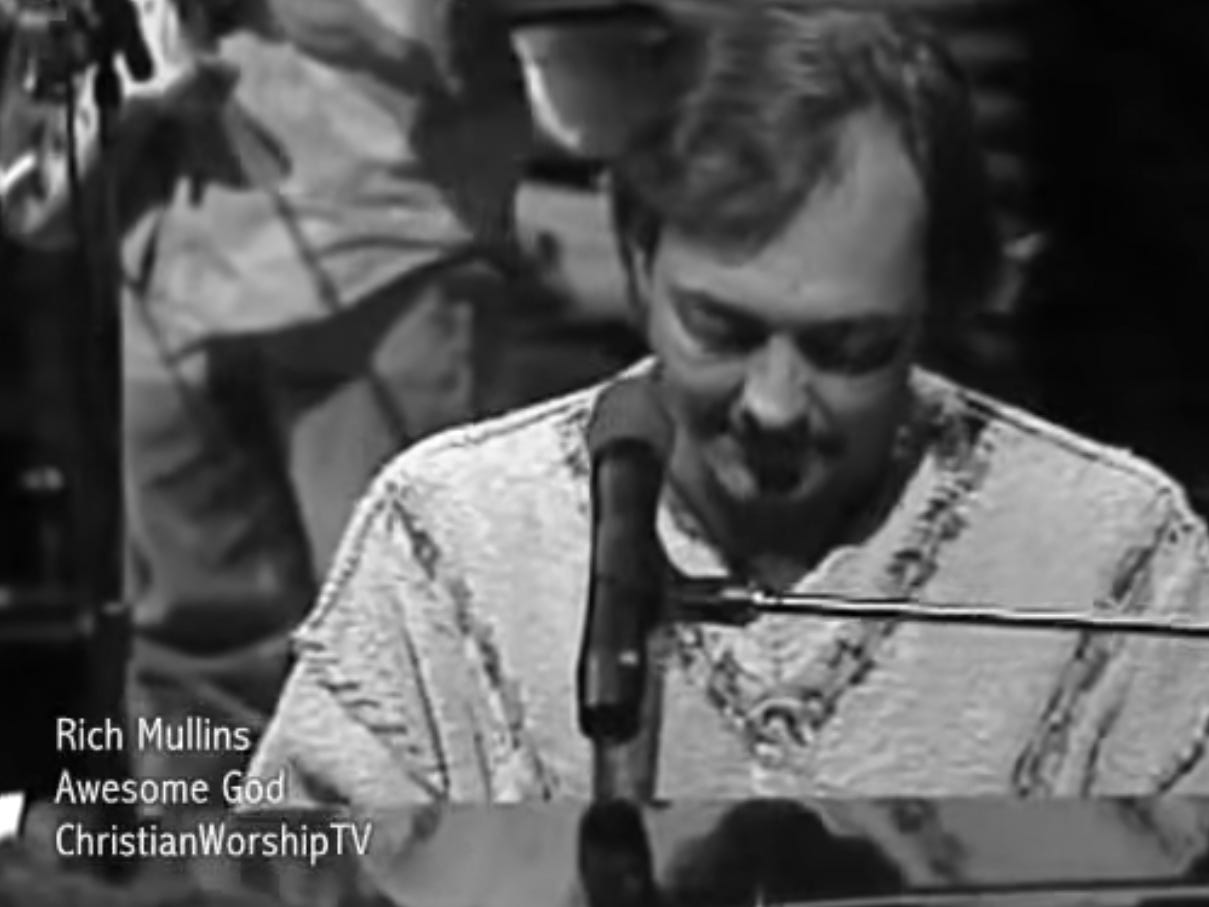
I grew up singing Rich Mullins at the top of my lungs in a church with burnt orange carpet. “Our God is an awesome God, He reigns from heaven above, with wisdom, power, and love, our God is an awesome God.” It was one of those songs that made you feel like the ceiling might lift off the building. Like something holy was actually happening. I still love that song. But somewhere between that burnt orange carpet and adulthood, I started noticing that the God many evangelicals seemed to worship wasn’t quite the one Rich Mullins was singing about. This one was less interested in wisdom and love and more interested in geopolitical conflict, military dominance, and a very specific countdown clock to the apocalypse.
When the End Times Became a Foreign Policy
Dispensationalism didn’t start as a political movement. It started as a theological system developed in the 1830s by an Anglo-Irish preacher named John Nelson Darby, who divided all of human history into distinct “dispensations” or eras in which God relates to humanity differently. Darby’s innovation, which was genuinely novel in Christian history, was the idea of the Rapture, a secret catching away of believers before a seven-year period of global tribulation, culminating in the literal return of Christ to reign on earth for a thousand years. This framework made its way to American shores, got picked up by the Scofield Reference Bible in 1909, became embedded in fundamentalist and evangelical institutions throughout the 20th century, and then absolutely exploded in popular culture when Hal Lindsey published “The Late Great Planet Earth” in 1970. By the time the Left Behind series sold 65 million copies starting in the 1990s, dispensationalism became a worldview, a political posture, and for many, a reason to stop caring about the earth altogether.
The theological mechanics matter here because they have real consequences. If you believe the world is in an irreversible prophetic tailspin toward Armageddon, and that your job is simply to hold on until the rapture whisks you away, then working for justice, tending to creation, or pursuing peace starts to feel pointless. Worse, it can start to feel like you’re working against God’s plan. Some dispensationalist thinkers have explicitly argued that Christians should support military build-up in the Middle East because conflict there is a sign of the end times being fulfilled. The logic is circular and terrifying. War then becomes a prophecy to be accelerated.
The Bomb in the Sanctuary
This is where evangelical infatuation with militarism starts to make a certain kind of terrible sense. When your theology tells you that America is uniquely favored by God, that Israel must be protected at all costs because of its role in end-times prophecy, and that strength is the primary language God speaks in the world, you end up with a Christianity that looks less like the Sermon on the Mount and more like a defense contractor’s wish list. You get pastors blessing fighter jets. You get sanctuaries wrapped in flags. You get a theology where “Our God is an awesome God” quietly becomes “Our God is an awesome bomb.”
N.T. Wright (one of leading New Testament scholars) has spent decades arguing that the entire dispensationalist framework is a misreading of scripture, particularly the book of Revelation, which was written as first-century apocalyptic literature to encourage persecuted Christians under Roman imperial rule. Not as a coded roadmap for 21st-century geopolitics. The beasts and empires in Revelation are references to Rome and its collaborators, written in the symbolic language that Jewish apocalyptic literature had used for centuries. Reading it as a prediction of Russian military movements or a European Union antichrist is like reading a political cartoon and thinking the bear with a sash labeled “Russia” is a zoological report. It’s ridiculous actually.
The damage this does to actual Christian ethics is enormous. Jesus said blessed are the peacemakers. He said love your enemies. He said put away the sword. These ideas were the central ethic of the kingdom he was announcing. When a theology builds an escape hatch out of history, it quietly gives believers permission to stop being responsible for it.
What We Lose When We Can’t Wait to Leave
There’s a grief underneath all of this that I think gets overlooked. Many of the people who absorbed dispensationalism did so not because they wanted to baptize violence, but because the theology offered them something genuinely appealing. Certainty. A map. The sense that history is going somewhere and that God is in control of it even when everything feels like it’s coming apart. I have enormous compassion for that longing. The world is terrifying. Making sense of it with a schema that says “this chaos is actually the plan” can feel like relief.
But it produces a faith that is fundamentally passive in the face of suffering and structurally incapable of lamenting what should be lamented. If the bombs are supposed to fall, you don’t pray for the people underneath them. You check your prophecy chart.
The Christianity I’ve come to inhabit believes that God is redeeming this world, not evacuating it. That the resurrection of Jesus was not a divine escape trick but a declaration that matter matters, that bodies matter, that history matters, and that the arc of creation is bending toward renewal. Jesus did not come to help us escape the world. He came to redeem it.
Singing a Different Song
Rich Mullins died in 1997 in a car accident in Illinois. By most accounts he was a man of genuine holiness, deep poverty of spirit, and real love for people on the margins. His God actually did reign with wisdom, power, and love.
The invitation in all of this isn’t to stop believing in a God who is awesome. It’s to ask honestly what we mean by awesome. Is it a God whose greatness is measured in fire and force and the righteous destruction of enemies? Or is it the God revealed in a baby in a feeding trough, in a teacher washing feet, in a man hanging on a cross praying for the people killing him? Because only one of those gods has anything to do with the gospel. And only one of them is worth singing about.


