
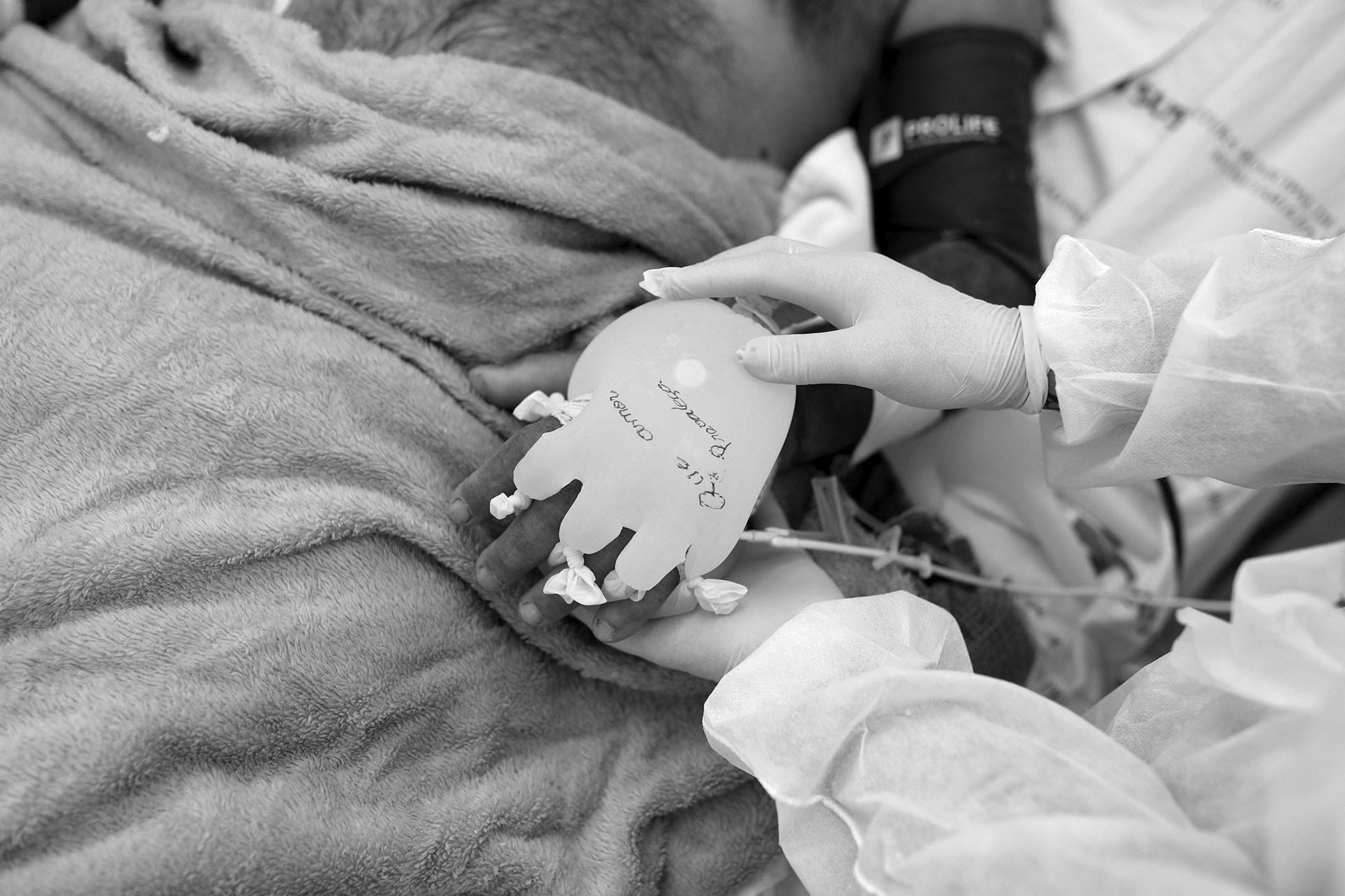
Maozinha do Amor
Little Hands of Love
I was doomscrolling again the other day and I ran across a post with a photograph from a Brazilian hospital during COVID-19 that I can’t stop thinking about. It shows a patient’s hand clasped between two water-filled surgical gloves, the latex fingers interlaced with human ones. The nurses called it “maozinha do amor” or little hands of love. When families couldn’t visit and touch was forbidden, these nurses filled disposable gloves with warm water and placed them on both sides of isolated patients’ hands.
I keep coming back to that image because it reminds me of something I learned the hard way. Sometimes the “right” way forward is completely blocked, and love has to get creative.
The One Right Way
I grew up believing there was a correct way to do everything that mattered. One right way to read the Bible. One right way to pray. One right way to worship, to evangelize, to structure a church, to understand salvation. The evangelical world I inherited was built on certainty, and certainty requires one right answer. Deviation was dangerous. It meant you were sliding away from truth, compromising with the world, and losing your grip on what mattered most.
So when I started asking questions that didn’t have easy answers, when the theology I’d been handed stopped making sense, when I couldn’t keep doing church the way I’d always done it, I felt like I was failing. The “right” way was still there, but I couldn’t walk it anymore. And the message I kept hearing echoing in my head was “if you can’t do it the right way, you’re doing it wrong.”
Finding Another Way
Here’s what those Brazilian nurses understood that took me years to learn…when the ideal becomes impossible, love doesn’t just give up. It improvises. It finds a way.
Those nurses knew what their patients needed. They needed the touch of someone who loved them, the warmth of a hand holding theirs, the physical reminder that they weren’t alone. But hospital protocols during a pandemic made that impossible. Family members couldn’t enter the ICU. The “right” thing, actual human contact, was off the table. So the nurses did something different. They filled latex gloves with warm water, tied them off like water balloons, and created a substitute for the impossible thing. It wasn’t perfect. It wasn’t the same as a daughter holding her father’s hand or a partner’s touch at the bedside. But it was tender. It was present. It was love working within constraints it didn’t create and couldn’t control.
The technique served a dual purpose. Warming patients’ cold hands improved blood circulation and prevented falsely low oxygen readings on monitors. But the deeper gift was emotional. As nurse Vanessa Formenton explained,
“The patient feels comforted as if someone were holding hands with them” (Reuters, April 2021).
When the real thing was impossible, something else became possible instead.

Jesus and Impossible Compassion
This is, I think, deeply biblical in a way that our obsession with the “one right way” often misses. Jesus spent his ministry breaking the rules when following them would have meant abandoning compassion. He healed on the Sabbath when the “right” thing was to wait. He touched lepers when the “right” thing was to keep your distance. He ate with sinners when the “right” thing was to maintain separation. Again and again, when the prescribed path meant leaving someone alone in their suffering, Jesus found another way.
The Pharisees had the lines clearly drawn. They knew the right way to observe the Sabbath, the right way to maintain purity, and the right way to approach God. But Jesus kept stepping outside those lines because he cared more about people than doing the “right” thing.
The Freedom in Impossibility
What I’ve discovered in my own journey away from evangelicalism is that sometimes the “right” way being impossible is actually a gift. It forces you to ask different questions. Not “How do I get back to doing this correctly?” but “What does love look like in this actual situation I’m in?” Not “What’s the prescribed answer?” but “Where is God showing up in the mess?”
For many of us deconstructing our faith, the old certainties aren’t just uncomfortable, they’re genuinely impossible to inhabit anymore. We can’t unknow what we’ve learned. We can’t unsee the harm done in the name of absolute truth. We can’t force ourselves back into a theological framework that no longer fits. The “right” way, as it was handed to us, is blocked.
But here’s what those Brazilian nurses show us…when the ideal is impossible, creativity becomes a form of faithfulness. When you can’t do the prescribed thing, you can still do something. You can fill latex gloves with warm water. You can find a different way to offer presence, comfort, healing. You can trust that God is bigger than the one right way you were taught.
Little Hands of Love
The image from that Brazilian hospital is what happens when we stop insisting on the impossible and start asking what’s possible instead. It’s about the radical compassion of saying, “I can’t give you exactly what you need, but I can give you this.” And sometimes, that’s enough. Sometimes, that’s everything.
If you’re reading this in the middle of your own impossible situation, if the faith you were handed doesn’t work anymore, if the community you belonged to has become unsafe, if the certainty you once had is gone, maybe you don’t need to find your way back to the “right” path. Maybe you just need to trust that love is more creative than you’ve been told. Maybe God is already meeting you in the warm latex and tied-off fingers of something new.
The hands of God aren’t always the ones we expect. Sometimes they’re improvised, imperfect, and completely different from what we thought we needed. But they’re still holding on.
Becoming Mainline is a reader-supported publication. Your generosity ensures this work continues and remains free to read. Thanks for your support.


Tears. Gratitude. After and in the midst of grief.
Jesus is always at least one step ahead of us. Thought provoking, thanks.