
4 Myths About America Being a "Christian Nation"
We’ve been lied to. Not maliciously—maybe—but we’ve been told a version of American history that sounds spiritual and patriotic. The story goes like this: America was founded as a Christian nation, the Constitution enshrines Christian values, and somewhere along the way secular forces hijacked what was rightfully ours. Sound familiar? I believed that story for years, but when I actually began reading the founding documents for myself, I quickly realized it just simply isn’t true. Not even close. So let me walk you through 4 myths that keep Christians from seeing what the founders actually built, and why the truth is actually better than the myth.
Myth #1: “The Constitution Establishes America as a Christian Nation”
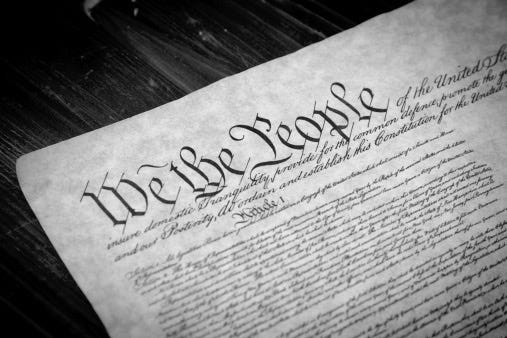
Open the Constitution and you won’t find Jesus, Christianity, or church anywhere in it. What you will find, in Article VI, is the exact opposite: “no religious Test shall ever be required as a Qualification to any Office or public Trust under the United States.”
This was revolutionary. In a world where governments used religious oaths to protect state churches, the founders said no, you don’t have to be Christian—or even believe in God—to serve in American government.
Then came the First Amendment: “Congress shall make no law respecting an establishment of religion or prohibiting the free exercise thereof.” No official church. No government-mandated faith. Just freedom, to believe or not believe, to practice any religion, or none. Make no mistake, that’s not Christian nation language. That’s religious liberty language. The Constitution doesn’t establish Christianity; it prohibits the government from establishing any religion at all.
Source: The Constitution of the United States: A Transcription | National Archives
Myth #2: “The Founders Were All Christians Who Wanted a Christian Government”
Were many founders personally religious? Sure. Were some specifically Christian? Yes. But here’s what matters: regardless of their private beliefs, they chose to build a government without religious requirements or establishment. Thomas Jefferson wrote in his Virginia Statute for Religious Freedom (1786) that people should never be “compelled to frequent or support any religious worship” and that beliefs must not affect “their civil capacities.” As president, he described to the Danbury Baptists (1802) “a wall of separation between church and State.”
James Madison went even further in his Memorial and Remonstrance (1785), arguing that religion can only be directed by “reason and conviction, not by force or violence,” so government has zero authority over it. Again, this wasn’t some kind of secular cynicism, it was theological conviction. Conscience belongs to God, not to Congress. Whatever the founders believed on Sunday, they deliberately built a secular government structure that protected religious freedom for everyone.
Sources: Virginia Statute for Religious Freedom | Thomas Jefferson’s Monticello
V. Thomas Jefferson to the Danbury Baptist Association, 1 Janu …
Memorial and Remonstrance against Religious Assessments, [ca. …
Myth #3: “Separation of Church and State Isn’t Really in the Constitution”
People love to say Jefferson’s “wall of separation” phrase doesn’t count because it’s not in the Constitution itself. But the principle absolutely is. The Establishment Clause and the No Religious Test Clause together create that wall. And the Supreme Court has consistently upheld it.
In Everson v. Board of Education (1947), the Court ruled that neither federal nor state governments can “set up a church” or “aid all religions” over non-religion. In Torcaso v. Watkins (1961), they struck down a Maryland rule requiring belief in God to hold office (exactly the religious test the founders banned). In Engel v. Vitale (1962), they barred government-composed prayers in public schools.
The wall isn’t just Jefferson’s metaphor; it’s constitutional architecture that’s been maintained for over two centuries.
Sources: Everson v. Board of Education | 330 U.S. 1 (1947) | Justia U.S. Supreme Court Center
Myth #4: “America Has Always Been Officially Christian”
When America needed to explain itself to the world, it was clear about what it wasn’t. In 1797, the U.S. Senate unanimously ratified the Treaty of Tripoli, which stated plainly in Article 11: “the Government of the United States of America is not in any sense founded on the Christian Religion.” This wasn’t a slip-up. It was official U.S. policy, signed by President John Adams, communicating to a Muslim nation that we weren’t a theocracy. It’s pretty stinking clear.
George Washington said the same thing in his 1790 letter to the Hebrew Congregation of Newport, writing that the U.S. government gives “to bigotry no sanction, to persecution no assistance.” No favored church. No second-class citizens because of faith. That’s the promise America made from the beginning.
George Washington to the Hebrew Congregation in Newport, Rhode …
Why This Matters for Christians
Here’s what every follower of Jesus needs to hear: none of this should feel threatening. Go back and read the Gospels. Jesus never asked Caesar to carry His cross. He never lobbied for Roman laws to enforce Sabbath-keeping. What Jesus did was call people, freely, personally, and radically to repent, believe, and love their neighbors. Period.
Let me put it bluntly: Coerced religion isn’t Christian faith. The founders built a civic structure where the church could actually be the church. For those of us who claim Jesus as Lord, our task has always been discipleship, not some sort of political or governmental dominance.
If our communities embody the Sermon on the Mount. If we’re known for mercy and peacemaking and enemy-love, we won’t need the government to certify us. The gospel has always spread best by grace and credibility, not by some kind of political privilege. The early church turned the Roman Empire upside down without holding a single senate seat. Read that again. Let that sink in. They did it by living and dying in a way that made people say, “Look how they love one another.”
The Better Path
What America offered wasn’t a “Christian nation” with all the cultural power that implies. It offered something better: a free nation where Christians could flourish by persuasion, where people of all faiths or no faith could flourish by the same right, and where the state played fair.
If we want a more Christ-shaped nation, the path isn’t to baptize the state or write our theology into law. The path is to be the church: loving neighbors, telling the truth, serving the poor, pursuing justice with humility, announcing good news with gentleness and respect.
The founders designed a public square where that witness can be offered freely. That’s the gift.
You can’t legislate people into the Kingdom of God. You can only love them toward it and trust the Holy Spirit to change hearts. We don’t need America to be a Christian nation. We need the church to be the church.
My goal is to help people think critically, love deeply, and follow Jesus with both courage and grace. If that mission resonates with you, you can support it by becoming a paid subscriber or by hitting the “Buy Me a Coffee” button below.


Overall a good post. You pulled your punches with myth 2. Some of the founders were strongly Christian. Others, Thomas Jefferson and Benjamin Franklin as notable examples, were deists and fit into the “Christian culture” of the day. Both by their writings and their behavior, they were not Christian. Sorry not to have references to support these assertions.
I think there is a difference between having a clear separation between church (organized religion) and state, and having one’s personal beliefs and devotion to Christ saturate and flavor the life of an elected official.
The last openly Christian president, who publicly said that he prayed about his decisions, was Jimmy Carter. It’s ironic that the “religious right” helped defeat his bid for reelection.
Beau, you just pulled off a theological plot twist - - turning the ‘Christian nation’ myth into a love letter to religious freedom. The irony? The more we demand political power for faith, the less room faith has to breathe. Maybe the founders weren’t trying to protect government from God, but God from government.
If religious liberty was designed to protect conscience from coercion, what happens when cultural identity itself becomes a kind of religion? Does nationalism count as the new creed?